
01
Legacy core
One change, one release window, one big risk - the vendor owns the roadmap, the venue owns the risk.
UNIFIN is a production platform built as microservices: 49 services, 9 client portals and 43 databases that launch new market products by configuration - and go live as a pilot in 2-4 weeks.
Legacy monoliths limit venues by release windows, integration cost and vendor roadmaps. The market needs infrastructure that scales with volume and absorbs new asset classes.
One change, one release window, one big risk - the vendor owns the roadmap, the venue owns the risk.
A new product takes 12-18 months of vendor backlog. Clients and regulators do not wait that long.
Turnover and participants grow every year while the old core scales only by buying more hardware.
Every bank, CSD and regulator needs a connector; point-to-point links multiply and fail silently.
Digital assets, commodities and derivatives arrive faster than a monolith can absorb them.
Per-seat and per-module licences make growth more expensive than the revenue it brings.
Already built, already running. Base licence for the core plus modular add-ons for microservices and data products: you pay for what you switch on.
Every function is an independent service with its own database, release cycle and contract - the same code runs a 3-node pilot and a national deployment.
49 microservices, 43 per-service databases, transactional outbox with schema-versioned events and DLQ replay.
Trading, post-trade, payments, risk, depository and data reuse the same identity, audit and reference data.
Kubernetes and Helm, rolling updates with zero downtime, Prometheus/Grafana dashboards and burn-rate SLO alerts.
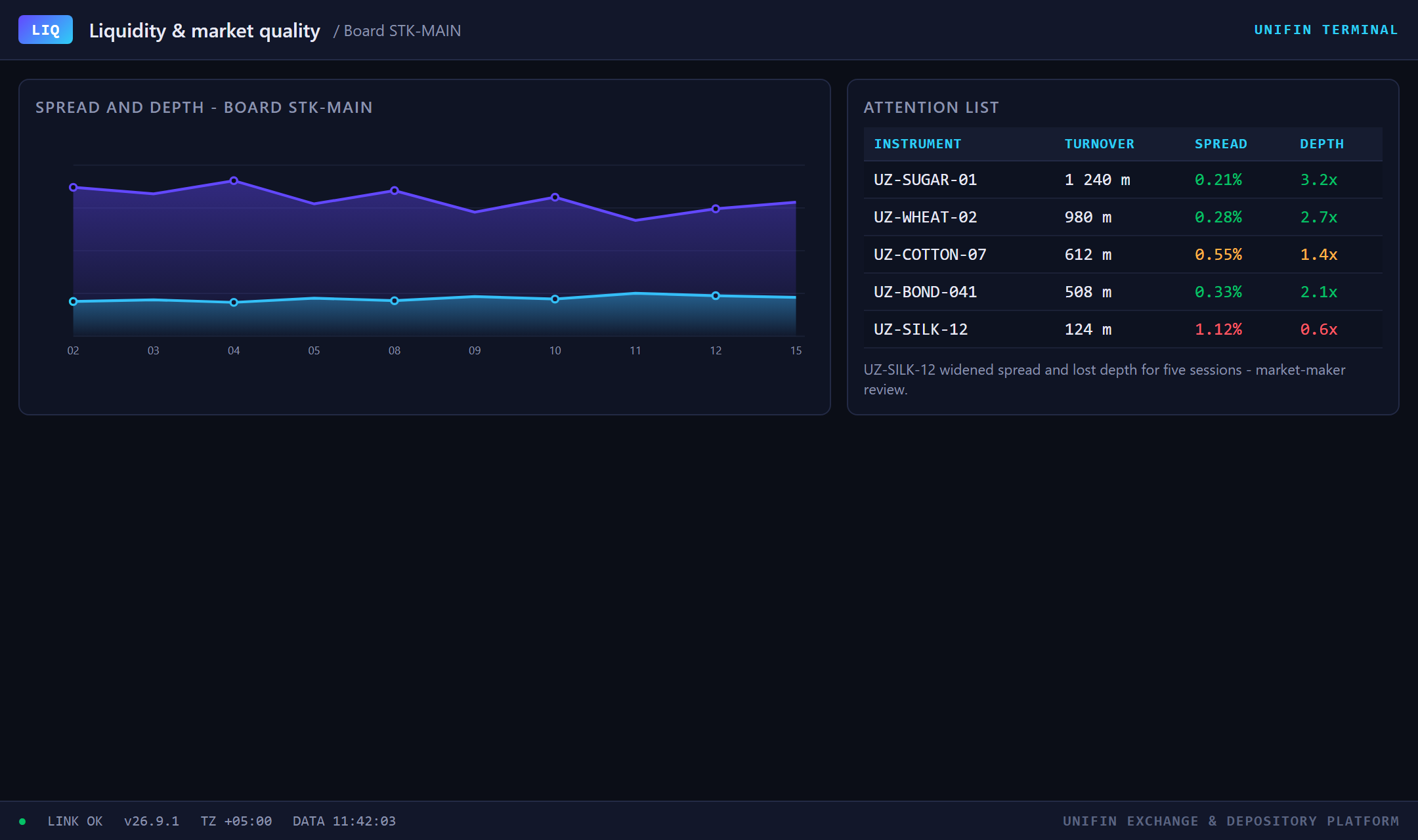
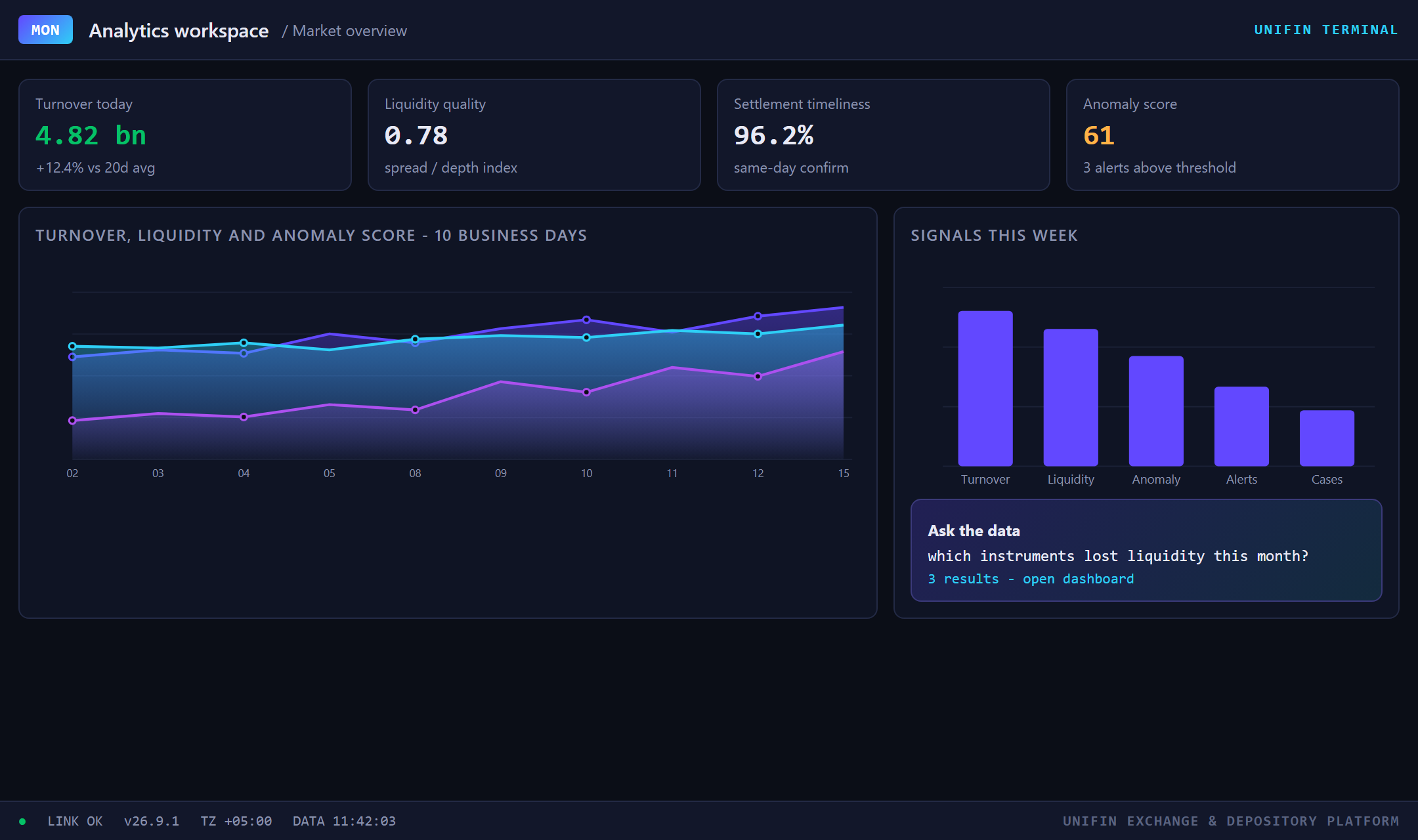
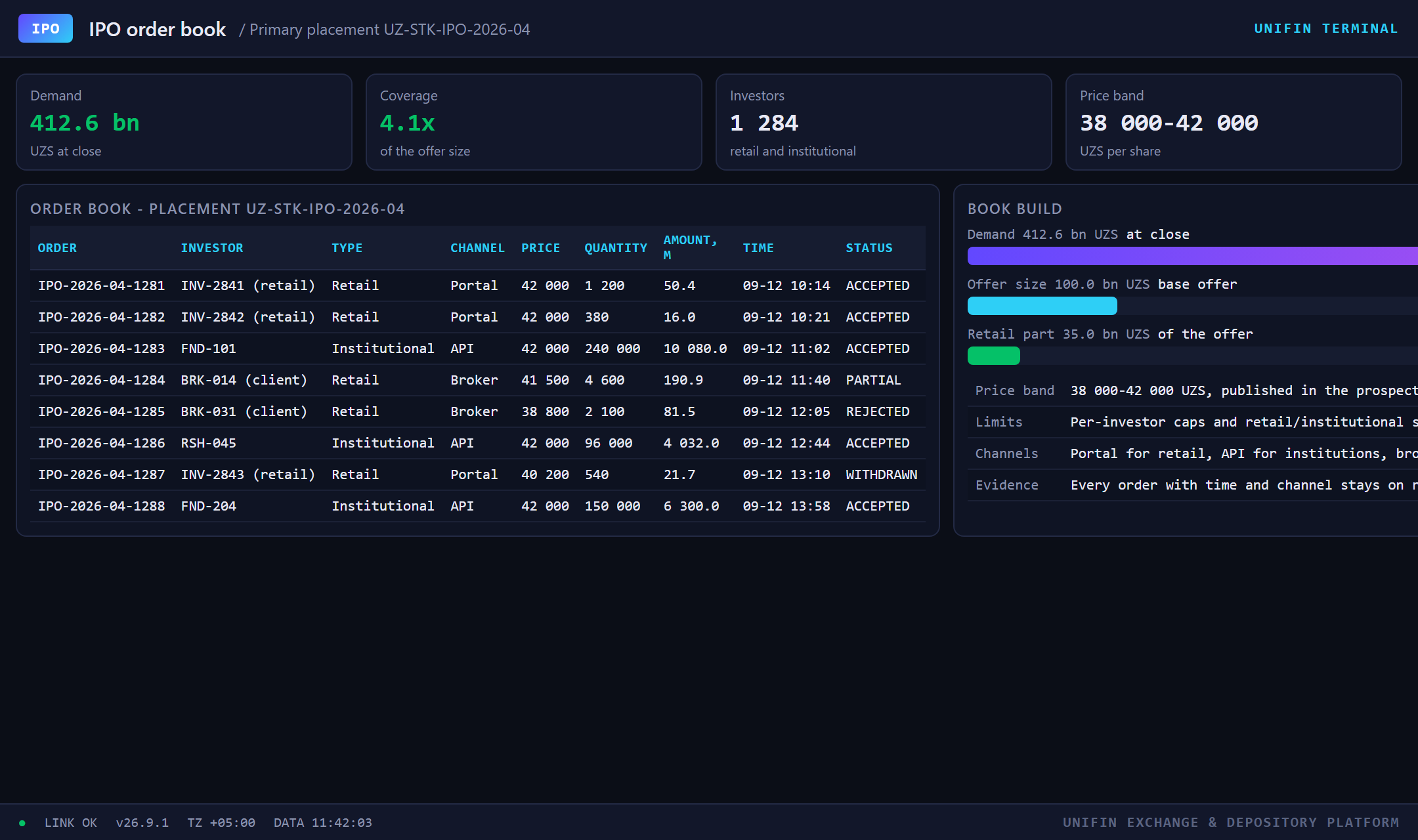
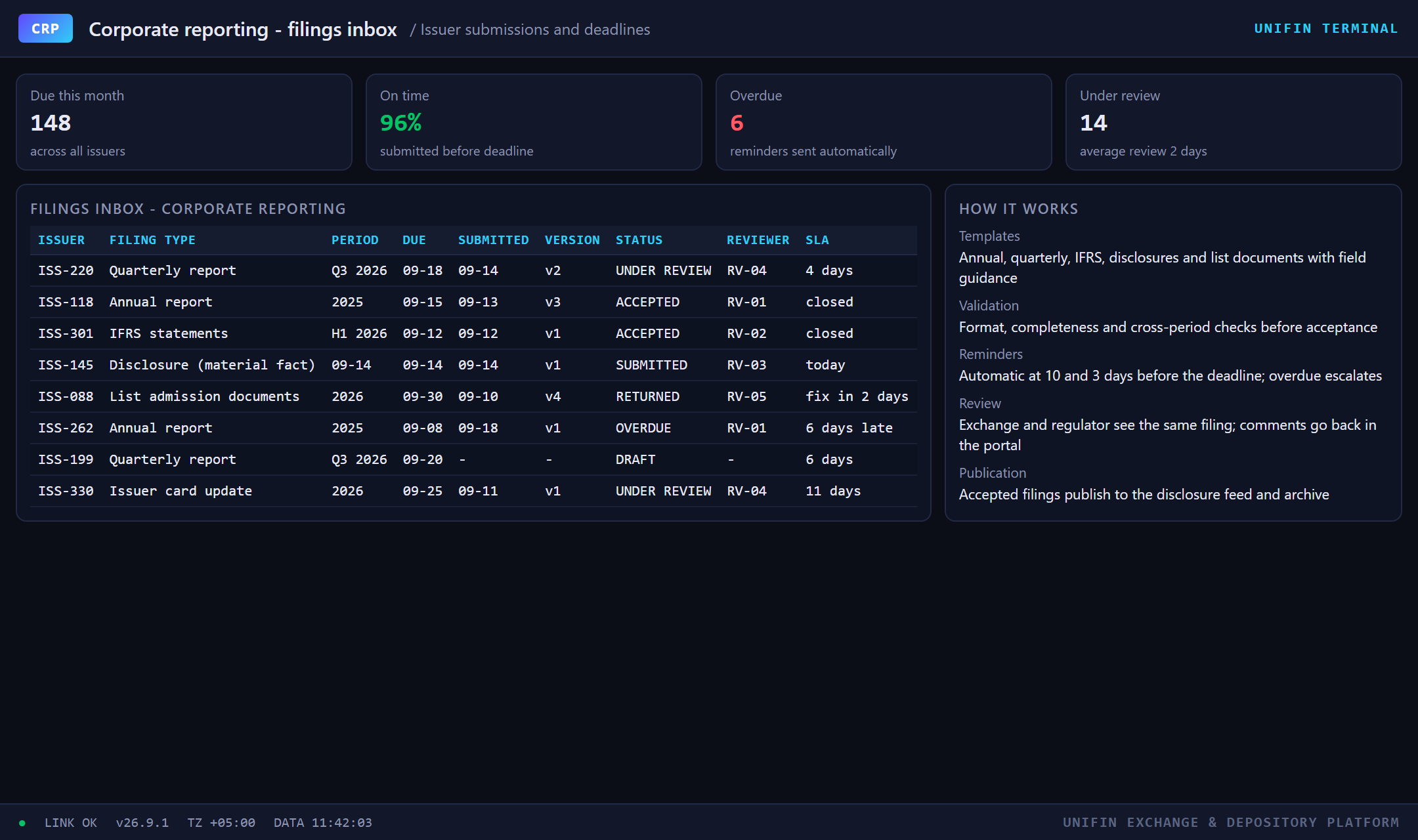
UNIFIN builds and operates exchange-grade systems. The platform on this page is in production: 49 microservices, 9 portals, 43 databases and 978 documented endpoints, delivered and supported by teams in Singapore, Abu Dhabi and Kazakhstan.
UNIFIN is an engineering company for market infrastructure. We design, build and operate exchange-grade platforms - trading, post-trade, depository, payments, risk and data - for venues, banks and financial groups, with teams in Singapore, Abu Dhabi and Kazakhstan.
The platform on this page is in production, not a concept. It replaced monolithic risk with 49 independent services, moved releases from yearly windows to weekly waves, and turned new products into configuration instead of multi-month projects.
We stay for the operational lifetime: pilot, rollout, service levels, disaster drills and support - one accountable team from the first scope call to national scale.
Twelve core capability groups are already running; each one is a microservice with a published API and its own release cycle.
Order book, auctions, OTC desk and RFQ, primary placements, market data and indices.
Clearing cycle, netting, margin calls, DVP settlement, custody accounts and corporate actions.
Payment orders, bank files and API channels, ISO 20022 and MT messages, FX conversion.
Pre-trade limits, sanctions screening, surveillance cases and regulatory reporting.
Onboarding and KYC, nine portals, document exchange, signatures and notifications.
Derivatives, digital assets, commodities, AI analytics, data subscriptions and training.
Each product reuses the platform rails - clearing, settlement, depository, identity and audit - and adds its own store, UI and commercial model.
Data locked inside the core; history requests take days.
Live streams, history and files with entitlements and metering.
Events run on spreadsheets; deadlines are missed.
Announce, approve, execute and pay with a full audit trail.
Deals closed in chat; delivery and payment decoupled.
RFQ, deal tickets, clearing and DVP settlement on one rail.
Allocations in Excel; coupons processed by hand.
Placement book, secondary trading, coupon and redemption runs.
No independent index; licensing uncontrolled.
Published methodology, streamed values, licensing and metering.
Reports arrive late; data is fragmented.
Natural-language questions over live data; dashboards and copilot.
Tokens cannot be admitted safely to the market.
Registry with lifecycle, admission rules and screening; classic settlement.
Margin calculated late in spreadsheets.
Futures and options with SPAN and variation margin, cash settlement.
Operations drown in routine; knowledge stays in heads.
Agents draft and summarise; people approve; every step is audited.
Click a product - the card opens with what it is, why it pays off with us and which pains from the top of the page it closes.
The same core assembles into a different product set every time. Pick who you are - the list updates instantly; the full scope is agreed on the call.
One hundred and ten product ideas across four tiers - from the shortlist we would launch first to the long tail that makes sense on partnerships. Every row opens a card: audience, platform basis, why we win and the main risk. Commercial terms are agreed on the call.
978 REST endpoints behind 126 gateway routes, grouped the DDD way: layers, bounded contexts and the endpoints that exist in the code today. Pick a layer, then a domain - the panel shows representative routes and how they are exposed.
Inventory snapshot from the codebase: controllers grouped by service. Full OpenAPI contracts are shared under NDA - the section above lists the platform-wide counts.
No exotic dependencies: a team familiar with Java, PostgreSQL and Kubernetes can operate the platform from day one.
3 nodes x 8 vCPU / 32 GB / 500 GB NVMe plus PostgreSQL primary and replica. Runs the full platform with production settings.
6+ nodes x 16 vCPU / 64 GB, Patroni x3, RabbitMQ x3, Redis Sentinel x3. Money-path pods spread with anti-affinity, rolling updates with zero downtime.
Add nodes horizontally: the same Helm chart deploys 3 or 30 nodes; databases stay small and owned.
Same code from pilot to national scale - capacity grows by adding nodes, not by rewriting the platform.
Latency budget: matching and validation stay in memory; storage, reporting and AI work asynchronously on events - the hot path never waits for the disk.
All 49 services own their database and scale independently: matching needs CPU, the data hub needs storage, portals need replicas. Under load we add pods for the hot service only - the rest keeps running, no maintenance window.
Standard channels on the edge, uniform rules inside: traceId end to end, idempotency keys, outbox in the same transaction and fail-closed money handling.
Pick the bricks your business needs. Every brick is a microservice with its own database and release cycle - you compose a product instead of writing a platform from scratch.
Market and operational analytics with an AI copilot.
Abuse detection, alerts and investigation cases.
RFQ, deal tickets, clearing and DVP settlement.
Placement book, allocations and listing day.
Issuer reports, corporate actions and signatures.
Secure document flow with a full audit trail.
Or your own product: gateway, identity, event backbone, rules and reports become a working pilot cluster with your scenario, users and data.
No long pre-sales: choose a scope and we deploy a working pilot cluster with your instruments, users and data - typically in 2-4 weeks.
About the company
Engineering and operating market infrastructure for exchanges and financial groups, with teams in Singapore, Abu Dhabi and Kazakhstan.
info@unifin.tech - corporate enquiries, partnerships
More about the product
Platform capabilities, data products and AI services: case studies, screen tours and the commercial model.
uni@unifinai.com - demos, pilots, commercial questions
We reply within one business day. If it is urgent, write to uni@unifinai.com.